

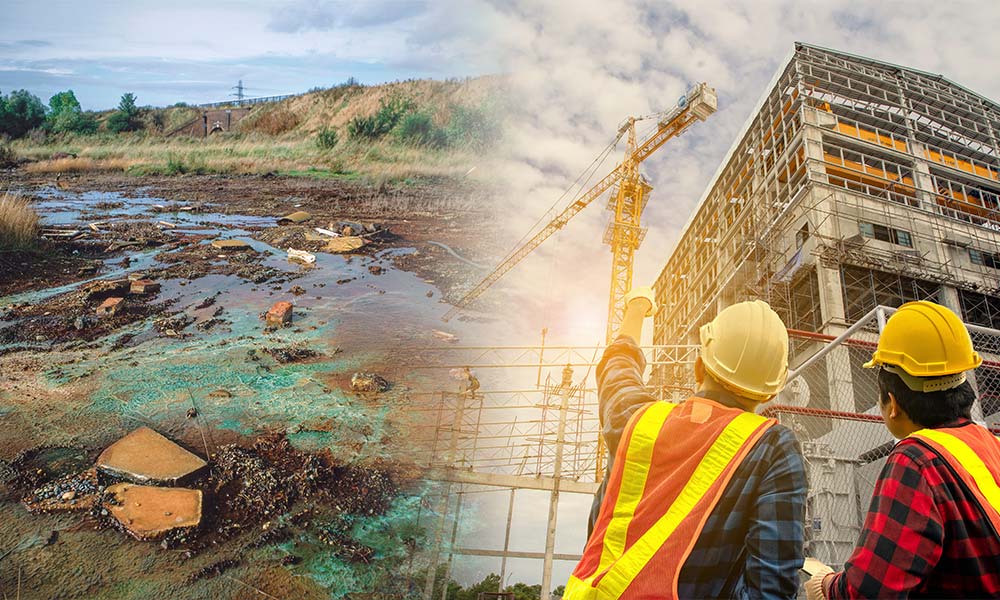
Brownfield redevelopment refers to the practice of turning over and reusing land that was once developed and may be environmentally contaminated. Across the US, brownfield redevelopment sites are, for example, old factory buildings, warehouses, rail yards, gas stations, and other industrial properties. Before redeveloping such properties for new commercial, industrial, or mixed-use purposes, environmental due diligence is necessary. A Phase I ESA is commonly conducted to evaluate potential environmental risks associated with a property’s historical and current use. This assessment plays a central role in identifying concerns that could affect liability, financing, regulatory compliance, and long-term site feasibility.
Understanding Brownfield Conditions
Brownfield sites usually have existing or suspected contamination, which makes redevelopment challenging. Most of the time, the historical activities have been associated with the storage, usage, or disposal of hazardous substances like petroleum products, solvents, heavy metals, and industrial chemicals. However, even if contamination is not present, the mere possibility of environmental damage might scare away the investors and hold up the deeds. The issues at stake might involve contaminated soils, polluted groundwater, vapor intrusion, or the existence of underground storage tanks.
These doubtful environmental conditions translate into financial and legal risks for the owners, developers, and lenders of the properties. The costs for cleaning up can be very high, and the federal or state environmental rules may hold the present or previous owners responsible. Consequently, a thorough investigation is necessary prior to the decision of redevelopment.
The Due Diligence Framework
Environmental due diligence for brownfield properties is primarily influenced by federal regulations that specify, among others, the rule of All Appropriate Inquiry under the Comprehensive Environmental Response, Compensation, and Liability Act (CERCLA). The adherence to these standards is part of the benefits a prospective purchaser gets by qualifying for certain liability protections. The evaluation process usually involves an examination of historical records, regulatory databases, aerial photographs, fire insurance maps, and other documentation to identify past uses that may have involved hazardous substances.
Besides document review, a site reconnaissance is done for the present condition observations and visible signs of contamination identification. Discussions with property owners, occupants, and local officials can also help reveal historical activities. The result of this process is a decision on the existence of Recognized Environmental Conditions. The findings thus guide the ensuing choices about further investigation or remediation.
Risk Identification and Mitigation
Environmental assessment is a key element in risk identification at an early stage. Finding and disclosing contamination before land acquisition or construction enables all the parties involved to evaluate the suitability of the project. Should environmental issues exist, additional stages like subsurface sampling or laboratory analyses might have to be carried out. Such a phased approach ensures that there are no surprises in terms of liabilities and that cost overruns are avoided.
Besides risk, mitigation may also relate to financial and contractual aspects. Environmentally challenged properties may have a reduced value, require special insurance cover, have restricted indemnification agreements, or become ineligible for public redevelopment incentives. Quite a few states run brownfield programs offering tax credits, grants, or liability protections to encourage the cleanup and subsequent reuse of such sites. Perfect environmental records are a major factor when one wants to take advantage of these programs.
Furthermore, confronting problems at the earliest stage means that remediation options can be better synchronized with the redevelopment work. Thus, plans for the removal of contaminated soils can be linked to the overall site grading, and vapor barrier installations can become part of the first building foundations. The alignment of environmental discoveries with engineering and construction activities helps avoid unnecessary interruptions and facilitates obtaining permits.
Supporting Sustainable Redevelopment
Brownfield redevelopment is one way of contributing to sustainable land use, as it brings back to life the areas that are not significantly used, like urban or industrial areas, instead of developing the land outside the city. An environmental assessment can be one of the keys to ensuring that the redevelopment of the brownfield site will not become a way of passing on contamination risks to future residents or neighbors. Besides that, it also helps real estate transactions become more transparent, and everyone’s health is protected.
The environmental review process results in documentation that establishes the condition of the site at the time of purchase. Such a record is often very helpful in showing that due diligence has been strictly observed. In the case of a very complicated brownfield redevelopment project, such papers may be used as a reference document by lenders, insurers, investors, and regulatory agencies.
Conclusion
Brownfield properties are a mix of possibilities and uncertainties. On the one hand, their redevelopment can be a source of new jobs, increase property values, and bring back to society lands which had been lying idle. On the other hand, environmental risks must be thoroughly evaluated and controlled in order not to face legal and financial issues later. Through structured investigation, regulatory compliance, and early identification of potential contamination, a phase I ESA serves as a foundational tool in supporting risk mitigation and responsible brownfield redevelopment nationwide.